Tell us about the job
Takes about a minute. No obligation.
A contractor called out to repair a central AC system in Dewey County is working through a short list of suspects shaped by what this area regularly delivers. 119 severe weather events were recorded in Dewey County, Oklahoma between 2015 and 2024. At that rate, the outdoor unit's capacitor, contactor, and condenser fan motor accumulate stress across season after season of hard running. A failure that looks sudden usually has a longer history behind it. That history is what a good diagnosis traces before any part gets ordered.
Opened equipment in a house this old tells you something specific: whether the refrigerant type, the capacitor spec, or the contactor the unit needs is still in regular production. Half the homes in Dewey County, Oklahoma were built in 1974 or earlier (2020-2024 ACS 5-year). That age of stock means a contractor doing repair work here has to price the job against parts availability, not just labor. A component that looks serviceable on the outside can belong to a line a manufacturer stopped supporting, and a repair that seems straightforward stalls when the part is sourced from a single distributor or is no longer sourced at all.
The Parts of a Central AC a Contractor Checks First
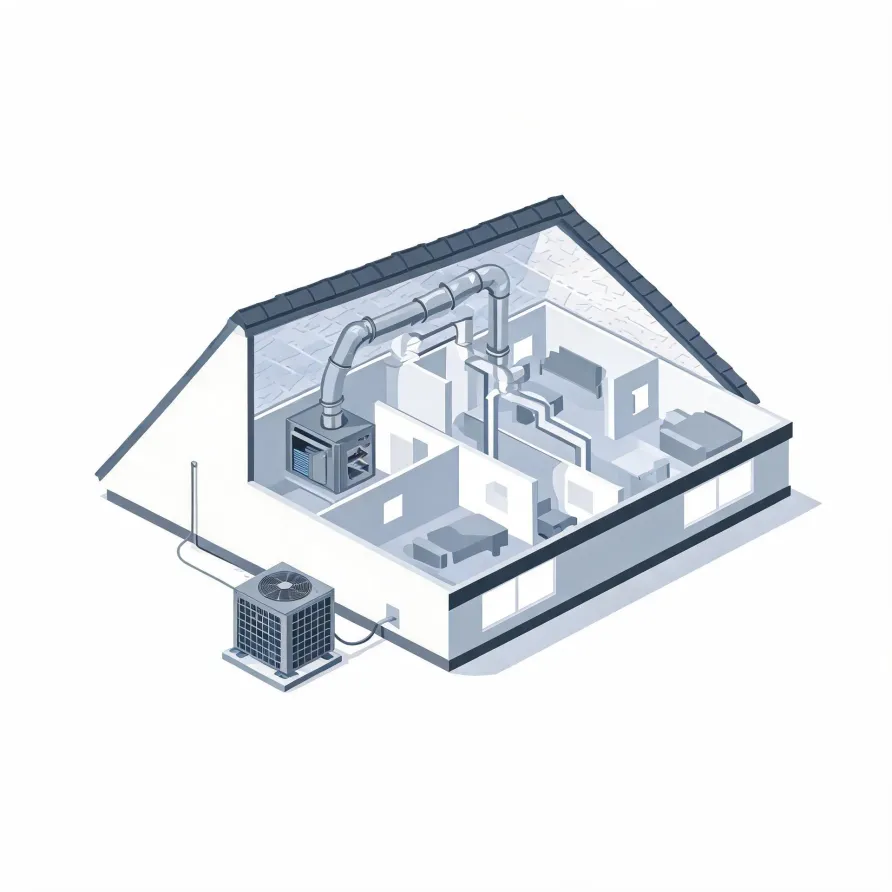
The outdoor condenser unit sits outside the house and holds the compressor and condenser coil, the two components a contractor reaches for first when a system stops cooling. The compressor is what drives the whole cycle, and a failed one is a common reason a system runs but produces no cold air. The condenser coil sheds heat to the outside air, and a dirty or damaged coil makes itself known quickly in a system that struggles on hot days.
Inside the house, the air handler or furnace cabinet holds the evaporator coil and the blower fan. The evaporator coil absorbs heat from indoor air, and a frozen or leaking coil is a frequent repair call. The blower moves conditioned air through the house, and the refrigerant lines that run between the two cabinets carry the charge a contractor checks whenever cooling performance drops.
The drawing shows the general layout of a central AC system, and a licensed contractor determines which components apply and what condition they are in for your specific house.
Get matched in Dewey CountyDewey County, by the numbers
119 severe weather events were recorded in Dewey County, Oklahoma between 2015 and 2024.
NOAA National Centers for Environmental Information, Storm Events Database, bulk CSV export, events 2015-01-01 through 2024-12-31.Half the homes in Dewey County, Oklahoma were built in 1974 or earlier (2020-2024 ACS 5-year).
U.S. Census Bureau, 2020-2024 American Community Survey 5-Year EstimatesDewey County, Oklahoma holds 2,184 housing units (2020-2024 ACS 5-year).
U.S. Census Bureau, 2020-2024 American Community Survey 5-Year EstimatesOwners occupy 76.4% of the occupied homes in Dewey County, Oklahoma (2020-2024 ACS 5-year).
U.S. Census Bureau, 2020-2024 American Community Survey 5-Year EstimatesCodes & Standards Governing Central AC Repair in Dewey County, Oklahoma10 sourced rules and standards
What HVAC Repair Looks Like in Dewey County
Split-system central air conditioners rated below 45,000 Btu/h manufactured on or after January 1, 2023 must meet a federal minimum of 13.4 SEER2.
Split-system central air conditioners rated at or above 45,000 Btu/h manufactured on or after January 1, 2023 must meet a federal minimum of 13.4 SEER2.
Split-system central air conditioners manufactured between January 1, 2015 and December 31, 2022 had to meet 13 SEER, the metric that preceded SEER2.
Single-package central air conditioners manufactured on or after January 1, 2023 must meet a federal minimum of 13.4 SEER2.
Space-constrained central air conditioners manufactured on or after January 1, 2023 must meet a federal minimum of 11.7 SEER2.
Federal efficiency standards for split-system central air conditioners and heat pumps are set on each certified combination of outdoor unit and indoor coil rather than on the outdoor unit alone.
Residential and light commercial air conditioning and heat pump systems assembled in the field, including mini-splits and unitary systems, may not be installed on or after January 1, 2025 using a refrigerant with a global warming potential above 700.
A field-assembled system whose specified components were all manufactured or imported before January 1, 2025 carries no installation compliance date under the refrigerant restrictions and may still be installed.
What Dewey County, Oklahoma Requires for HVAC Repair Work
An Oklahoma mechanical licence is valid statewide, and a contractor licensed by a local authority who works only in that locality is not required to hold the state licence at all.
Oklahoma requires a Construction Industries Board licence for mechanical work: nobody may do or advertise mechanical work as a journeyman or contractor without the right licence.
Severe Weather Events in Dewey County
Oklahoma weather puts real stress on cooling equipment, and what hits Dewey County hits the units running through it. Repair demand tracks closely with what the sky does, which makes local weather history a useful part of understanding why central AC systems here need the attention they do.
119 severe weather events, 2015–2024. Source: NOAA National Centers for Environmental Information, Storm Events Database.